
How to Prepare for Life After University 💡


Thinking about applying to a university in Germany? Whether you’re a local student or looking to study abroad, the German university system is one of the most versatile, affordable and practically focused in the world and really offers something for everyone.
In this complete guide, we’ll cover everything you need to know about universities in Germany, including the different types of universities you can attend, how funding and admissions work and which universities rank as the best in the country. Sounds good? Let’s dive in!
TL;DR: There are four main types of universities in Germany: traditional universities, universities of applied sciences, art colleges and dual universities. Germany’s top universities rank among the best in the world, while the country’s tuition fees are some of the lowest around and a major benefit of studying here.
Before deciding which university is right for you, it’s key to understand your options. Generally, they’re split into four main types or pathways:
To make things simpler, we’ve put together a table comparing each one:
University Type | Size | Courses | Academic focus | Student life | Fees | International students | Best for |
Traditional universities | Large institutions, typically 10,000–25,000+ students | Humanities, sciences, medicine, law, economics, engineering | More academic and research-focused | Lots of student societies, sports clubs and campus activities | Mostly public, meaning no tuition fees; semester contributions apply | Many international and English-taught courses | Academic programmes, research or careers requiring advanced qualifications |
Universities of applied sciences | Smaller and more focused, typically 2,500–15,000 students | Business, engineering, IT, social sciences, design, health | Practical and career-focused | More personal, practical environment, strong links to employers | Mix of public and private funding so fees vary | Many international programmes available | Practical experience and a direct route towards a career |
Colleges of art | Usually small; typically 250–1,000 students | Fine art, graphic design, fashion, photography, music, acting, film | Highly practical, studio-based | Creative and collaborative, with exhibitions, performances and productions | Mostly public so no tuition fees, some private colleges | Typically smaller international cohorts, admission can be competitive | Students pursuing careers in the creative industries |
Universities of cooperative education | Mixed size; typically 1,000–5,000 students | Business, engineering, IT, economics, health, social sciences | Combines university study with paid practical work | Less active social life as campus time is limited | Mostly public so no tuition fees, students may receive a salary | Generally only for domestic students due to hiring barriers | Students prioritising work experience and job security |
Let’s break down each type in a bit more detail…
Typically the largest and most historic universities in the country, traditional universities (Universitäten) place a strong emphasis on theory and research. Most are publicly funded, and the top institutions rank among the world’s best.
If you’re looking to complete a Bachelor's or Master's programme in a large, sociable university setting, this is the right route for you. They cover a vast range of subjects and are generally the main route to a doctorate in Germany.
Universities of applied science (Fachhochschule) are much more focused on practical application, providing hands-on experience and industry learning. The main courses they specialise in are business, engineering and social sciences, prioritising real-world applications over studying from books.
Usually smaller than traditional universities, this route offers a more personal, career-led environment, often resulting in better job-placement rates – so it’s a great option for future job security.
For those with a creative flair, arts colleges (Kunsthochschule) are the place to be. Specialising in courses such as music, design and performance, these institutions aim to give students as much practical grounding as possible and award a degree at the end of the course.
Admissions can be tough, as arts colleges typically only accept a small number of students each year, and you may be required to submit a portfolio, attend an audition or complete an interview to showcase your skills.
Universities of cooperative education (Duale Hochschulen), or simply dual universities, offer dual study programmes (Duales Studium) which are run in partnership with local employers and split your time between studies and work – half of the time spent at university, the other half working (and earning!) in a role related to your field of study.
It’s worth noting that many universities of applied sciences offer dual study programmes too. They’re a popular option for local students – around 5% of students opt for dual study – but international students may find it harder to get accepted as they require strong German fluency and a signed employer contract alongside university enrolment.

So, where should you study in Germany? With different types of institutions and course options, deciding can be tricky, especially since Germany has multiple highly ranked universities in the world’s top 100.
We’ve compiled a list of the top 10 universities in Germany so you can get an insight into campus life, facilities, and career opportunities, and start to get a feel for which one might be right for you.
Regularly topping the annual rankings, the Technical University of Munich (TUM) has much to offer! Focusing specifically on research, innovation and entrepreneurship, its subject strengths include:
On campus, you’ll brush shoulders with students from around 140 countries. TUM students get to use the sports facilities built for the 1972 Olympic Games as their official university sports grounds (pretty cool, right?). Plus, with its thriving tech and business scene, it offers plenty of opportunities for internships, graduate jobs and start-ups.
📍 Location: Munich, Germany
🧑🎓 Student population: 52,000
🥇 Germany ranking: #1
🌎 World ranking: #25
Source: QS World University Rankings
Another highly ranked, Munich-based institution, the Ludwig Maximilian University of Munich (LMU Munich) excels in a wide range of courses, including:
The LMU Munich campus is integrated into the heart of Munich, making the trendy Maxvorstadt district your personal playground. Not only does the university work hard, but Munich offers unique ways for you to let off steam too – students can be found river surfing between classes at the famous Eisbachwelle during break!
📍 Location: Munich, Germany
🧑🎓 Student population: 53,000
🥇 Germany ranking: #2
🌎 World ranking: #61
Source: QS World University Rankings
Especially known for its medical expertise, Heidelberg University is split across three main hubs in the historic city of Heidelberg: the Old Town (humanities), Bergheim (social sciences), and Neuenheimer Feld (natural sciences and medicine). Popular courses include:
With unique sights to explore – like the student prison where misbehaving students were locked up during the 19th and early 20th centuries – the university has a fascinating history. The international community is large, with students coming from around 130 countries.
📍 Location: Heidelberg, Germany
🧑🎓 Student population: 32,000
🥇 Germany ranking: #3
🌎 World ranking: #86
Source: QS World University Rankings
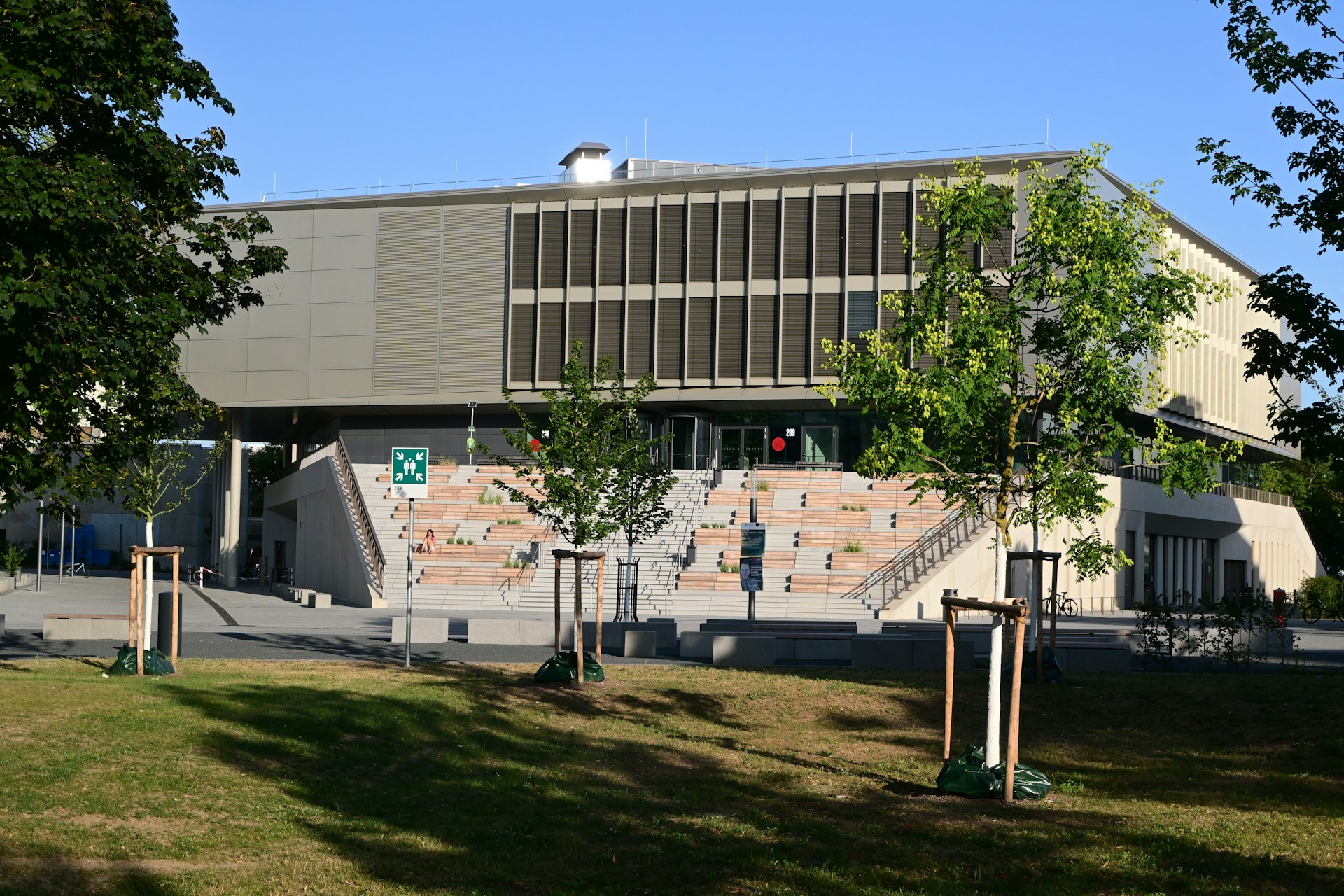
With a big focus on international and interdisciplinary research, the Free University of Berlin‘s (FU Berlin) many and varied course strengths include:
FU Berlin’s main campus is in Dahlem – a leafy, wealthy villa district – making it feel a touch more tranquil than other Berlin universities. It has its quirks, too, with the ‘Berlin Brain’ library on campus, which is shaped exactly like a human brain!
📍 Location: Berlin, Germany
🧑🎓 Student population: 34,000
🥇 Germany ranking: #4
🌎 World ranking: #98
Source: QS World University Rankings
With a serious reputation for research, industry, and innovation, RWTH Aachen University is packed with specialist laboratories and research facilities, with key strengths in scientific fields like:
The university has a huge international student population and strong connections with companies, providing internship and career opportunities. In fact, many students secure job offers before they even finish their course — how’s that for employment prospects!?
📍 Location: Aachen, Germany
🧑🎓 Student population: 44,000
🥇 Germany ranking: #5
🌎 World ranking: #104
Source: QS World University Rankings
Another major university with a strong focus on tech and engineering, Karlsruhe Institute of Technology (KIT) is split between four main campuses in the charming city of Karlsruhe with key strengths in:
KIT’s Campus South is located right next to the grand Karlsruhe Palace, essentially turning the palace gardens into an unofficial campus lawn for studying and relaxing. You can expect plenty of unique clubs and societies, like KA-RaceIng, where students build and race their own electric Formula Student cars.
📍 Location: Karlsruhe, Germany
🧑🎓 Student population: 23,000
🥇 Germany ranking: #6
🌎 World ranking: #110
Source: QS World University Rankings
With a strong research output and varied course offering, Humboldt University of Berlin (HU Berlin) holds a rich history as Berlin’s oldest university. Top-ranking subjects include:
The university is spread across four different campuses, with the main one on Unter den Linden boulevard, right in the heart of Berlin. Student life is rich and varied, with plenty to get involved in, from sports clubs and musical groups to the student-run UnAufgefordert newspaper.
📍 Location: Berlin, Germany
🧑🎓 Student population: 36,000
🥇 Germany ranking: #7
🌎 World ranking: #140
Source: QS World University Rankings

With research and innovation at its core, the Technical University of Berlin (TU Berlin) is primarily based in Berlin’s upscale Charlottenburg district and has key subject strengths in:
Campus life is exciting and vibrant, with sociable events like garden projects and beer brewing (yes, you heard that right!). TU Berlin also has a large and diverse student community, with international students making up close to a third of the overall population.
📍 Location: Berlin, Germany
🧑🎓 Student population: 34,000
🥇 Germany ranking: #8
🌎 World ranking: #158
Source: QS World University Rankings
Based in the stunning city of Dresden, Dresden University of Technology (TU Dresden) is another of Germany’s best universities with particular strengths in:
Split between two central locations in the city, TU Dresden is home to specialised research facilities delivering pioneering work in fields like biomedicine and microelectronics. The university is great for nature lovers, too, as it manages the historic Dresden Botanical Garden and the scenic Forest Park Tharandt arboretum.
📍Location: Dresden, Germany
🧑🎓 Student population: 29,000
🥇 Germany ranking: #9
🌎 World ranking: #185
Source: QS World University Rankings
Last but certainly not least, the University of Bonn is another standout option mixing beautiful campus surroundings with high-quality teaching and a lively social scene. There’s a strong research culture, too, with specialisms in:
The main building is a former baroque palace in the heart of the city, overlooking the large lawn of the Hofgarten, which serves as the main gathering point for students and university events throughout the year. Cologne is also just a short hop away by train and a popular student destination for weekend trips and nights out!
📍 Location: Bonn, Germany
🧑🎓 Student population: 31,000
🥇 Germany ranking: #10
🌎 World ranking: #209
Source: QS World University Rankings
So, you’ve got the details on the different types of universities in the country – but how do you apply? Good news: the process is fairly straightforward once you know what to expect, so we’ll break it down for you below.
To study at a German university, you’ll need a recognised university entrance qualification (Hochschulzugangsberechtigung or HZB). If you didn’t go to school in Germany, don’t worry – your high school qualifications will likely match German standards. For example, in the UK, the equivalent would be three passing grades at A Level.
You’ll also need to meet the relevant language requirements. These are usually German for German-taught courses or English for English-taught courses. Everything else is fairly straightforward — here’s the full list of what you’ll need:
Preparatory course for international students
If you're an international student and your home country’s qualifications don’t qualify as a university entrance qualification, you’ll need to attend a one-year preparatory course (Studienkolleg). This lasts for two semesters and will focus on a specific course similar to your intended university subject.
The course concludes with a final exam (Feststellungsprüfung or FSP), which you’ll need to pass to receive the HZB that allows you to apply to a German university. However, this will be subject-restricted, meaning you can only apply to courses in your chosen study area.
How the ‘Numerus Clausus’ affects admission
The Numerus Clausus (NC) is essentially a restriction on admissions used for highly competitive courses where there are more applicants than available places, such as medicine, dentistry and other specialised subjects.
The number is based on the grades of applicants from the previous semester, and the lowest grade of an accepted student becomes the official NC for the next cohort. This then stands in place of the usual minimum entry requirements, so your high school grades will need to match or exceed the NC in order for you to be accepted.
When you’re ready to apply, you’ll usually do so directly through your chosen university’s website. Some universities also use the Uni-Assist portal, a special route for international students which evaluates international certificates and qualifications.
To apply, you’ll need to:
Deadlines vary between universities, but most programmes have application windows around May to July for the winter semester, and November to January for the summer semester – but be sure to check the exact dates with your chosen university.

It’s no secret that Germany is one of the most affordable places in the world for university tuition, but there are still costs involved. These vary depending on whether you’re applying to a public or private university, as well as if you’re a domestic or international student.
Studying in Germany can be very affordable — especially at state universities! Here’s what to expect from both public and private universities:
Additional fees for international students
International students also have to factor in application fees. If you’re applying through Uni-Assist, the first application costs €75, while each additional application in the same semester costs €30, so applying to several universities can add up.
Non-EU students will also need to budget costs associated with your student visa and residence permit. These include application fees and the deposit required for a blocked account (Sperrkonto), which is usually required to secure a visa and totals €11,904 per year.
Germany has numerous funding options, both for local and international students. If you’re eligible, BAföG can help cover living costs. It’s based on your household income and is available to German citizens and certain international students depending on your nationality and residence status.
International students can also explore scholarships through the German Academic Exchange Service (DAAD). These offer funding for a wide range of study and research programmes, though they can be competitive.

Now that you know everything about German universities, the next step is deciding which one is right for you so you can properly start your university journey! After that comes the excitement of booking accommodation and preparing for your move — and that’s where we come in…
Here at Yugo, we offer a wide range of student accommodation across Germany. So whether you’re heading for the bright city lights of Berlin or the towering skyscrapers of Frankfurt, we have the perfect living space waiting for you when you make the move.

Compare the different types of student accommodation in Germany, learn about booking requirements and discover the best places to search, all in our handy guide.
Learn all about German student visas, from eligibility requirements and application process to fees and what documents you’ll need.
A complete guide to student jobs in Germany, from Mini-Jobs and Werkstudent roles to internships and HiWi positions.